
The situation
When Lois died in December 2013, she left her estate in the hands of her daughter, Kerrie-Ann.
It seemed like a straightforward decision. Kerrie-Ann lived nearby in regional Victoria. She was organised and capable. The estate wasn’t large — the main asset was the family home in the small town of Murtoa, about 300 kilometres northwest of Melbourne.
But Lois had two other children. Her sons, Malcolm and Garry, lived in Queensland. And they were furious.
The brothers contested the will. They lost. The court ruled in Kerrie-Ann’s favour. She remained executor.
That should have been the end of it.
It wasn’t.
What went wrong
By 2019, the siblings hadn’t spoken in nearly eight years. Malcolm had called the real estate agent handling the sale of the house, accusing Kerrie-Ann of “killing their mother.” He said he would “continue to take items from the house until there was nothing left.”
The property had already sold once for $99,000, but the sale fell through after water damage — damage the brothers were suspected of causing.
When the house was relisted for auction in March 2019, the brothers made a plan.
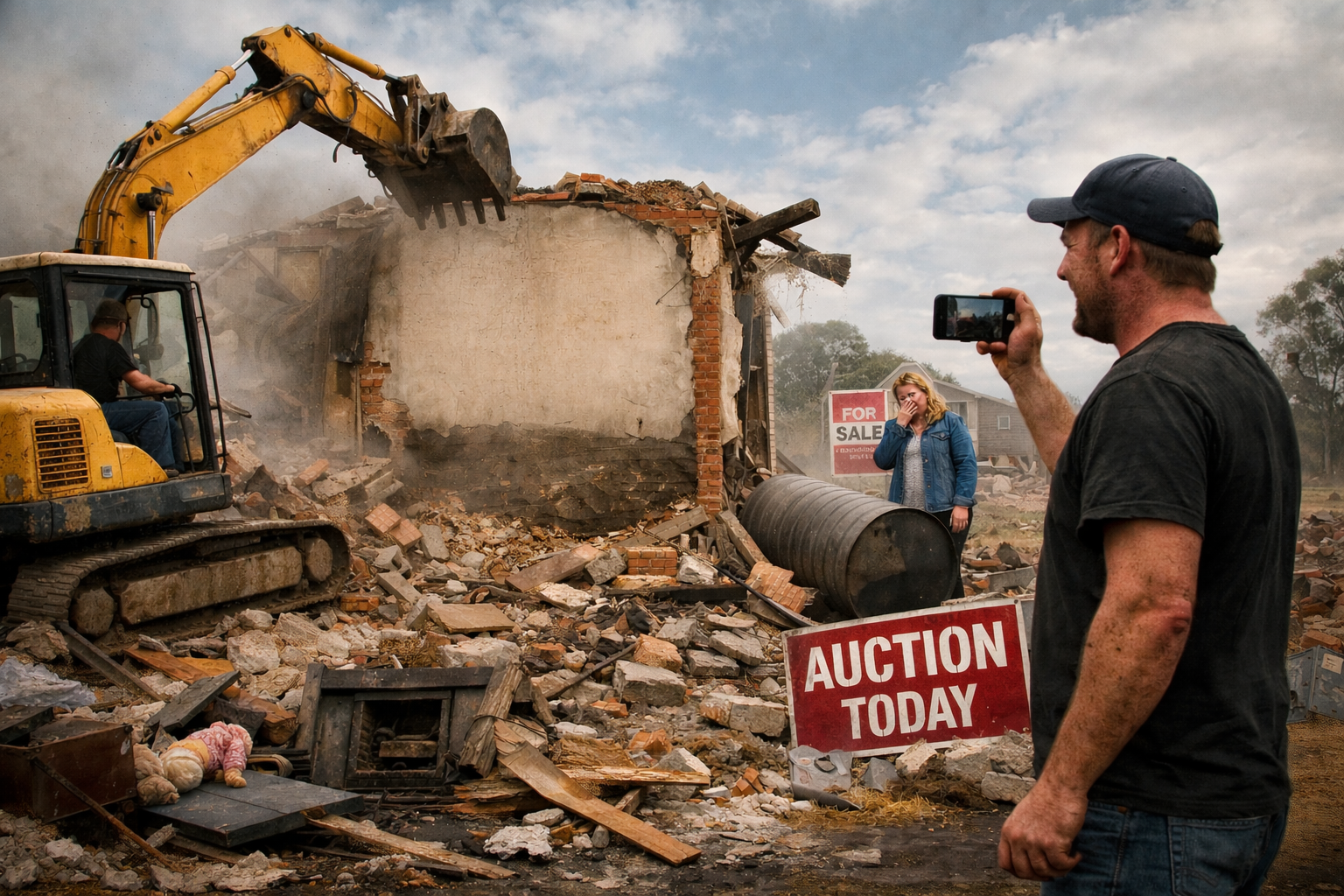
They flew from Queensland to Victoria. They hired an excavator from the nearby town of Horsham. And the day before the auction, they went to work.
For thirty minutes, they took turns demolishing the house. Walls came down. Windows shattered. The fireplace was ripped out. The toilet was dragged into the street. One brother operated the machine while the other filmed, laughing.
Inside, they spray-painted the bedrooms. One message read “Lois was murdered here” with the outline of a body on the floor.
They rolled the property’s water tank down Murtoa’s main street, leaving it at an intersection.
Then Malcolm sent a text message to his sister: “Renovations have begun.”
That night, the brothers drove to Melbourne to watch an AFL game. They posted a selfie on social media with the caption: “Few beers at the footy after a hard day’s renovating.”
They were arrested the next morning at their airport hotel.
The impact
The auction went ahead the following day. But there was no house left to sell — just rubble, broken glass, and graffiti.
Divided between the three siblings, that meant $2,500 each.
The brothers had destroyed their own inheritance. They had destroyed their sister’s share too. And they had turned a private family dispute into a criminal matter.
The cost wasn’t just financial. Whatever remained of the family relationship was gone. The brothers admitted they hadn’t spoken to their sister in years and referred to her in court with language too offensive to repeat.
Grief had curdled into hatred. A house that could have provided for three families became worthless.
The outcome
In July 2021, Malcolm and Garry Taylor faced Victoria’s County Court. They pleaded guilty to theft and criminal damage.
The judge, Michael Cahill, did not hold back.
You were laughing while you destroyed your sister's inheritance. Now the world is laughing at you for your stupidity.
Each brother was fined $10,000. They avoided jail, but the footage of their destruction had gone viral. Their names were now permanently attached to one of Australia’s most bizarre estate disputes.
The judge noted what was obvious to everyone watching: “Family disputes bring out the worst in people.”
What could have helped
This case is extreme. Most family conflicts don’t end with an excavator. But the underlying dynamics — resentment, miscommunication, and the feeling of being treated unfairly — are common.
Appoint a neutral executor. Lois chose Kerrie-Ann, which her sons interpreted as favouritism. A professional executor might have reduced the sense that one sibling had “won.”
Address conflict early. By the time the brothers demolished the house, they hadn’t spoken to their sister in years. Mediation earlier in the process might have helped — or at least prevented the dispute from escalating to destruction.
Communicate the reasons behind your decisions. If Lois had explained why she chose Kerrie-Ann as executor — in a letter, or through a solicitor — the brothers might have felt less excluded.
Recognise when grief becomes something else. The brothers’ actions weren’t rational. They were driven by years of unresolved anger. When emotions run this high, professional support — legal, psychological, or both — can prevent tragedy.
Why this matters
This case made headlines because it was so dramatic. But underneath the excavator footage was something familiar: siblings who couldn’t agree, an estate that became a battleground, and a family that tore itself apart.
Estate disputes rarely end well when they’re driven by emotion rather than reason. Legal costs mount. Relationships fracture. And sometimes, assets are destroyed entirely.
The lesson isn’t complicated. If you’re making a will, think carefully about how your choices might be perceived. If you’re a beneficiary, remember that the estate belongs to the deceased — not to you. And if you’re an executor caught between warring siblings, get professional help early.
No inheritance is worth what this family lost.
Related topics
- Executor
- Family Provision Claim
- Devastavit
- Can I leave someone out of my will?
- Who should I choose as my executor?
Based on the Taylor brothers case, Victoria County Court, 2021. Some details have been anonymised.